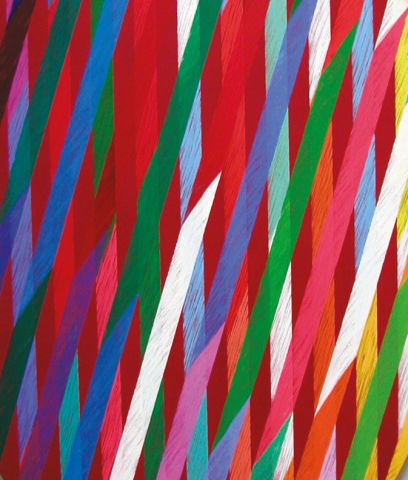
Curated by Nadia Stefanel
The Arts House, Singapore
1-7 October 2025
Quantum Perspective: The Art of Interference – Where Science Meets Imagination
Singapore, 1–7 October 2025 – To mark the International Year of Quantum Science and Technology (IYQ), the Dino Zoli Foundation and DZE Asia Pte Ltd present Quantum Perspective: The Art of Interference, an unprecedented art exhibition curated by Nadia Stefanel. Hosted at The Arts House in Singapore during the Formula 1 Singapore Grand Prix (1–7 October 2025), the exhibition invites audiences to experience the strange and fascinating world of quantum physics through the lens of contemporary art.
This year also celebrates the centenary of quantum mechanics, recognized by the United Nations as one of the greatest milestones in human knowledge. The exhibition brings together Italian and Singaporean artists in a cross-cultural dialogue, turning the invisible principles of quantum theory into striking visual and sensory experiences.

A Dialogue Between Science, Art, and Speed
Formula 1 embodies technological excellence, precision, and the ability to act in split seconds—qualities that mirror the behaviour of quantum particles. Just as teams of drivers, engineers, and mechanics work in perfect synchronicity, entangled particles influence one another in real time. Pit stops, strategies, and data analysis echo the role of quantum observers, where every action changes the system itself.
Through themes such as high-speed perception, time dilation, and the manipulation of light, Quantum Perspective offers spectators new metaphors to interpret the synergy between science and motorsport.
Featured Artists
The exhibition features works by Wan Kyn Chan, Ina Conradi and Mark Chavez, Giacomo Costa, Giuliana Cuneaz, Elena Lo Giudice, Vincenzo Marsiglia, Leonardo Petrucci, Jake Tan with Ezequiel Ignacio Rodríguez Chiacchio, and Bao Song Yu.
Highlights include:
- Quantum Quirks by Giuliana Cuneaz, where shifting forms embody the beauty of uncertainty and translates the paradoxes of quantum mechanics into playful, engaging images.
- Stroboscopic Star by Vincenzo Marsiglia fuses quantum physics with the focus of Formula 1, turning probability and motion into rhythmic geometries, colours, and light, inspired by telemetry and quantum oscillations
- Circuit n.1 by Giacomo Costa fuses Formula 1 speed with quantum uncertainty, turning the city into luminous particles detectors and circuits
- Inside the Box by Leonardo Petrucci fuses Schrödinger’s paradox with Night Race, turning uncertainty into an artistic meditation on reality
- 1 Qubit by Jake Tan, with Ezequiel Ignacio Rodríguez Chiacchio and with Bao Song Yu transforming quantum information into a tangible experience, mirroring Formula 1’s balance of speed, precision, and uncertainty
- Superposition in black and white by Elena Lo Giudice merges motorsport and quantum physics, suspending legendary drivers between victory and defeat until observed
- Wan Kyn Chan’s meditative precision, echoing the double-slit experiment with Formula 1’s Night Race, transforming light data into layered form
- Immersive projections Quantum logos by Ina Conradi and Mark Chavez, recalling wave superposition through light and motion into an immersive meditation on uncertainty and creation
Together, these artists give form to the unseen, bridging science and imagination just as Formula 1 transforms physics into spectacle.
Wan Kyn Chan
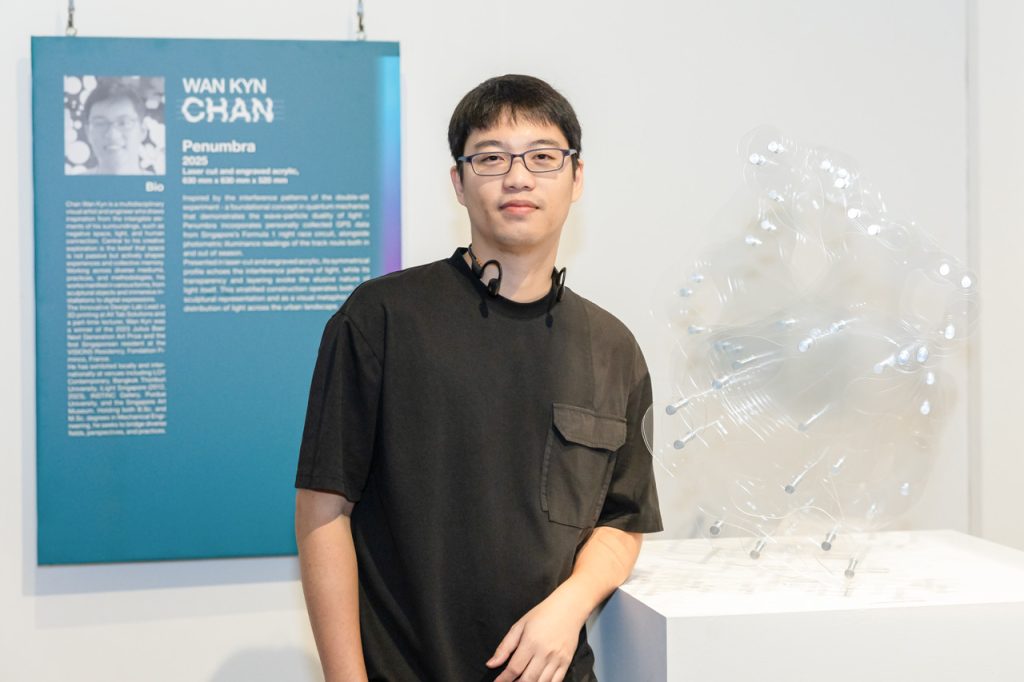
Penumbra, 2025
Laser cut and engraved acrylic, 0.75m x 0.75m x 0.75m
Inspired by the interference patterns of the double-slit experiment—a foundational concept in quantum mechanics that demonstrates the wave–particle duality of light—Penumbra incorporates personally collected GPS data from Singapore’s Formula 1 night race circuit, alongside photometric illuminance readings of the track route both in and out of season. Presented in laser-cut and engraved acrylic, its symmetrical profile echoes the interference patterns of light, while its transparency and layering evoke the elusive nature of light itself. This stratified construction operates both as a sculptural representation and as a visual metaphor for the distribution of light across the urban landscape
Ina Conradi and Mark Chavez
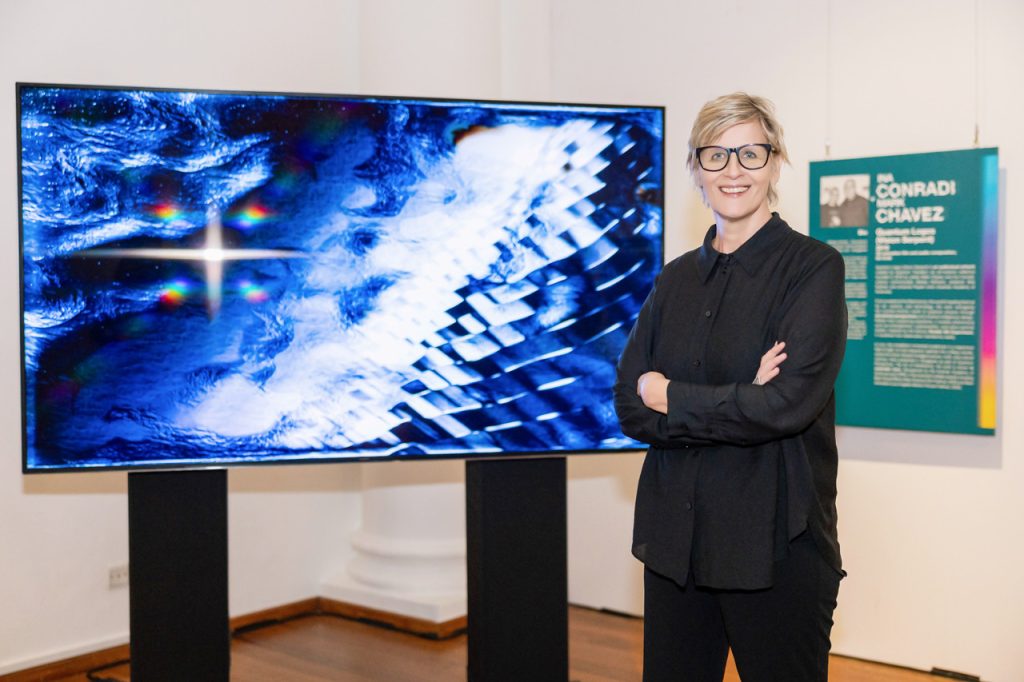
Quantum Logos (Vision Serpent)
Premiere: Ars Electronica Festival 2019 – 40th Anniversary, Deep Space 8K
Quantum Logos (Vision Serpent) is an audiovisual artwork created by Quantum Travelers—an art–science collective founded in 2018 by artists Mark Chavez and Ina Conradi, science communicator Bianka Hofmann, producer Bob Kastner, and physicist Rupert Ursin (Austrian Academy of Sciences). First unveiled at Ars Electronica, the world’s leading festival for art, science, and technology, the work reimagines the counter-intuitive world of quantum physics through decolonial perspectives and intuitive Indigenous design. Rather than explaining equations, it evokes phenomena such as entanglement, superposition, and wave–particle duality. Inspired by the famous Double Slit Experiment, it visualizes how observation transforms reality.
In Linz, the installation immersed audiences in a responsive field of light; its final sequence opened into a Maya cenote, where the Vision Serpent bridged science, myth, and cultural memory. Now presented in Singapore as part of Quantum Perspective: The Art of Interference, the work is shown in cinematic form. Recognized by the Austrian Academy of Sciences and CERN, it has received multiple awards including Best Visual Effects (Raw Science Film Festival, 2020) and Best Animation (Los Angeles Motion Picture Festival, 2020).
Giacomo Costa
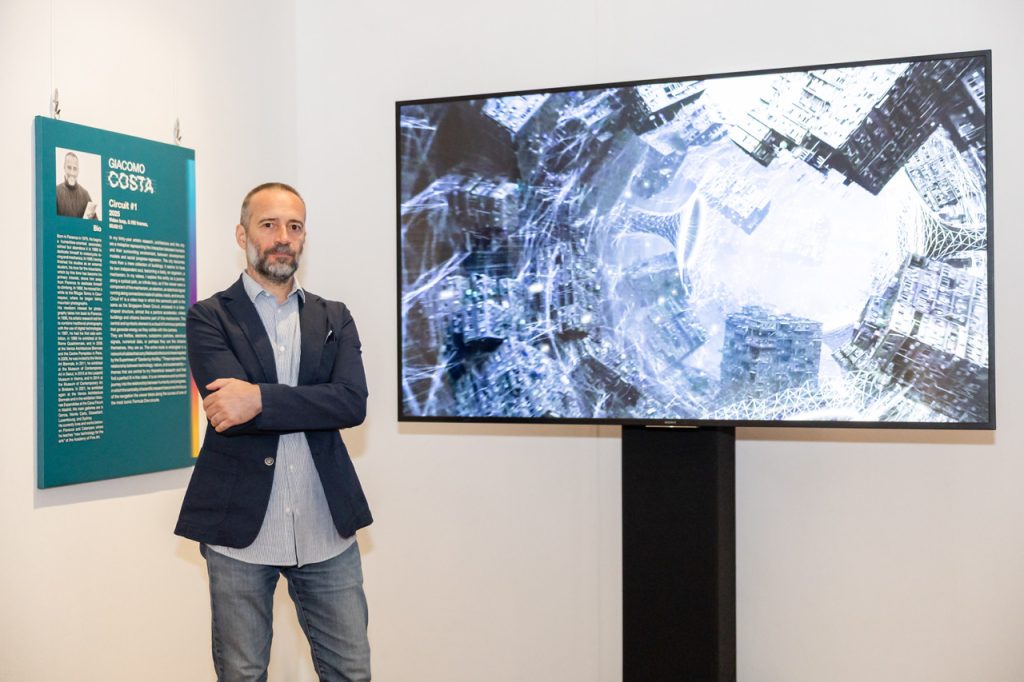
Circuit #1, 2025 video
In my thirty-year artistic research, architecture and the city are a metaphor representing the interaction between humans and their surrounding environment, between development models and social progress-regression. The city becomes more than a mere collection of buildings; it seems to have its own independent soul, becoming a body, an organism, a mechanism.
In my videos, I explore this entity as a journey along a cyclical path, an infinite loop, as if the viewer were a component of the mechanism, an electron, an electrical signal running along connections made of cables, roads, and circuits. Circuit #1 is a video loop in which the camera’s path is the same as the Singapore Street Circuit, enclosed in a tube-shaped structure, almost like a particle accelerator, where buildings and citizens become part of this mechanism. The central and symbolic element is a cloud of luminous particles that generate energy as they collide with the camera. They are fireflies, electrons, subatomic particles, electrical signals, numerical data, or perhaps they are the citizens themselves, they are us. The entire route is entangled in a network of cables that carry lifeblood to the iconic trees inspired by the Supertrees of “Garden by the Bay.” These represent the relationship between technology, nature, and sustainability—themes that are central to my theoretical research and that find a perfect fit in this video. It is an immersive and symbolic journey into the relationship between humanity and progress, in which the centrality of scientific research becomes the focus of the navigation the viewer takes along the curves of one of the most iconic Formula 1 circuits.
Giuliana Cuneaz
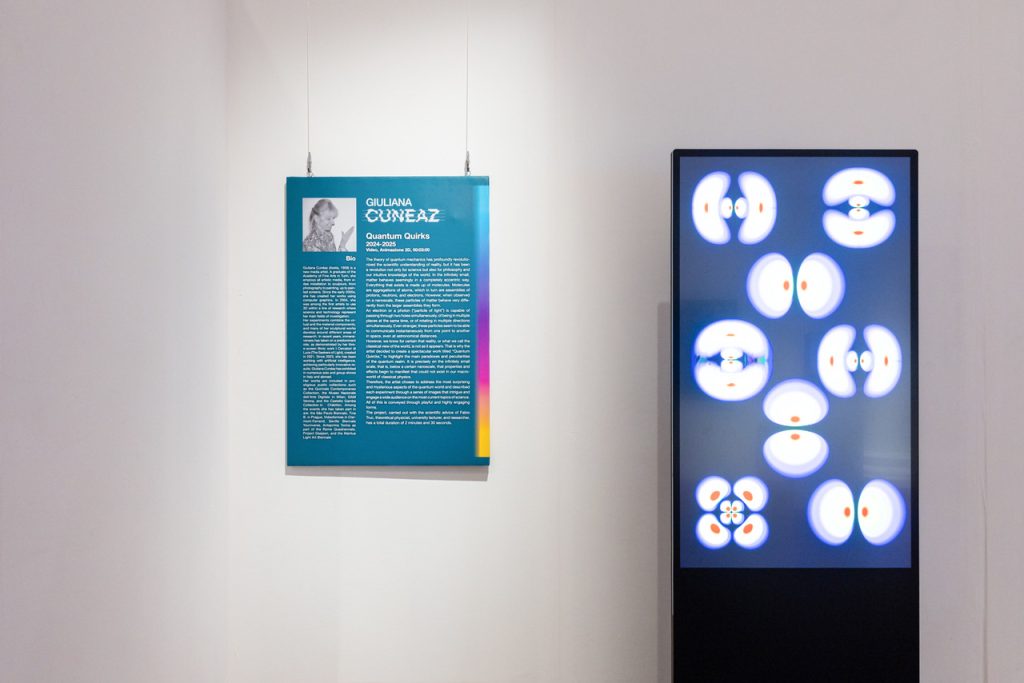
QUANTUM QUIRKS, 2024-2025, video
The theory of quantum mechanics has profoundly revolutionized the scientific understanding of reality, but it has been a revolution not only for science but also for philosophy and our intuitive knowledge of the world.
In the infinitely small, matter behaves seemingly in a completely eccentric way. An electron or a photon (“particle of light”) is capable of passing through two holes simultaneously, of being in multiple places at the same time, or of rotating in multiple directions simultaneously. Even stranger, these particles seem to be able to communicate instantaneously from one point to another in space, even at astronomical distances.
However, we know for certain that reality, or what we call the classical view of the world, is not as it appears. That is why the artist decided to create a spectacular work titled “Quantum Quircks,” to highlight the main paradoxes and peculiarities of the quantum realm. It is precisely on the infinitely small scale, that is, below a certain nanoscale, that properties and effects begin to manifest that could not exist in our macro-world of classical physics.
Therefore, the artist choses to address the most surprising and mysterious aspects of the quantum world and described each experiment through a series of images that intrigue and engage a wide audience on the most current topics of science. All of this is conveyed through playful and highly engaging forms.
The project, carried out with the scientific advice of Fabio Truc, theoretical physicist, university lecturer, and researcher, has a total duration of 2 minutes and 30 seconds.
Elena lo Giudice
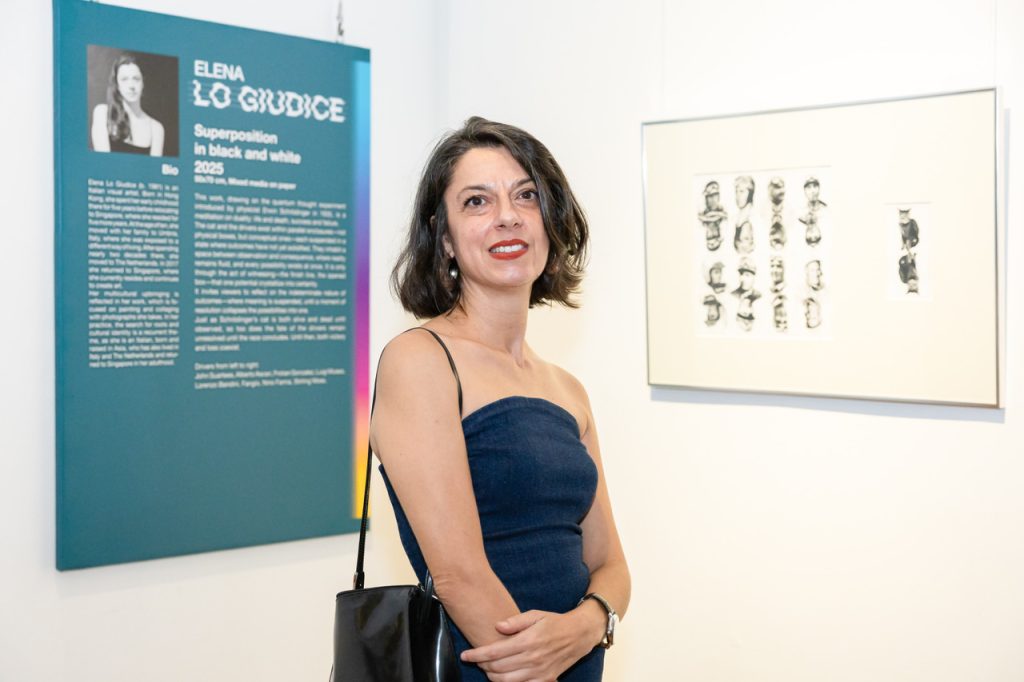
Superposition in black and white, 2025
This work, drawing on the quantum thought experiment introduced by physicist Erwin Schrödinger in 1935, is a meditation on duality: life and death, success and failure. The cat and the drivers exist within parallel enclosures—not physical boxes, but conceptual ones—each suspended in a state where outcomes have not yet solidified. They inhabit a space between observation and consequence, where reality remains fluid, and every possibility exists at once. It is only through the act of witnessing—the finish line, the opened box—that one potential crystallize into certainty. It invites viewers to reflect on the indeterminate nature of outcomes—where meaning is suspended, until a moment of resolution collapses the possibilities into one. Just as Schrödinger’s cat is both alive and dead until observed, so too does the fate of the drivers remain unresolved until the race concludes. Until then, both victory and loss coexist.
Name of drivers: John Suartees, Alberto Ascari, Frolian Gonzalez, Luigi Musso; Lorenzo Bandini, Fangio, Nino Farina, Stirling Moss
Vincenzo Marsiglia
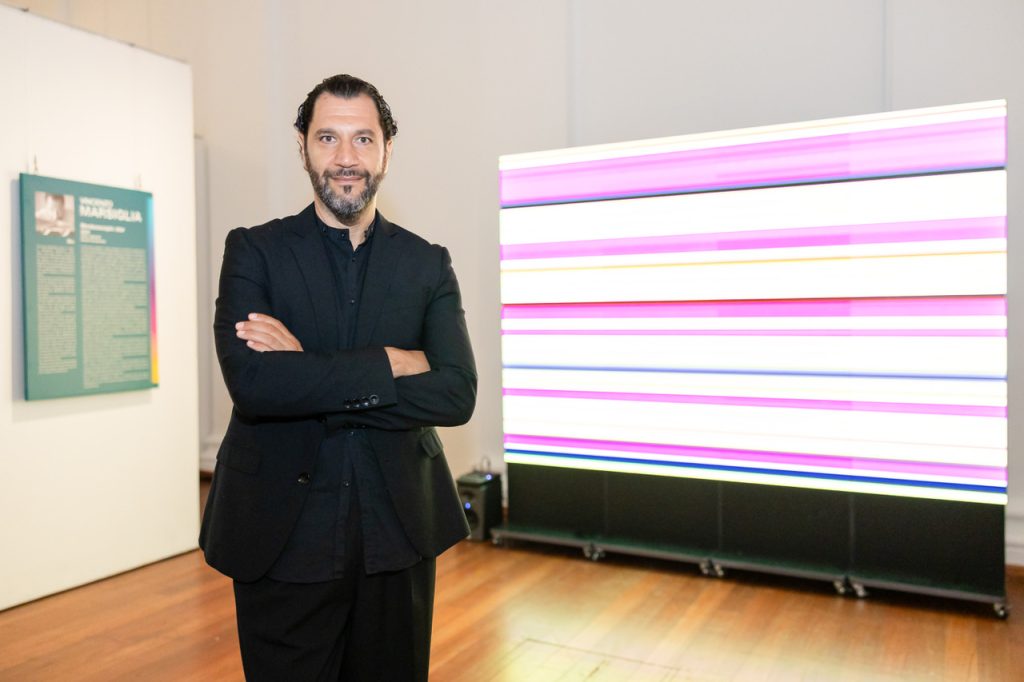
STROBOSCOPIC STAR, 2025, video
In this new project, I have chosen to confront myself with a territory that has always fascinated me: quantum mechanics, a dimension in which matter manifests itself in the form of probability, relation, energy/ light, all themes of my research. The starting point is once again my Unit Marsiglia (UM), the geometric star shape that I have been using for years as a structure, signature and lens to observe the world. In this research, UM is ideally transformed into an atom: a dynamic nucleus from which new forms, trajectories and geometries are born in continuous transformation. In the quantum sphere, movement is never certain: it is a map of possibilities, a space between what is and what could be. With my works I try to bring this instability into the visible, transforming it into rhythm, color, rotation. The movement of the video thus becomes the reflection of the movement of thought, as if the mind itself follows the trajectory of particles that never let themselves be defined completely. It is the mind that orients the gaze, that imagines developments. Looking at this work, we are like in the mind of a driver who, to prepare for the race, runs the circuit only with thought. Every turn is anticipated, every possible variation is contemplated in silence, with lucidity. It is in that mental space – suspended between prediction and presence – that movement takes shape: not as an instinctive response, but as the effect of a perfectly clear inner vision. The oval, orbital shapes, often drawn on several axes, evoke the behaviour of matter and radiation and their invisible but powerful interactions. UM rotates, multiplies, disassembles and recomposes: from this process new geometries emerge, figures that appear and disappear, in a continuum between optical art, spirituality and science. The video is accompanied by a sound processing that is never a simple comment, but an integral part of the process capable of generating new visual evolutions. The sound will be curated by the artist Ocrasunset. Color is the protagonist, often in contrast with the black background, as in the cosmic space, as in the depths of the unconscious.
Leonardo Petrucci
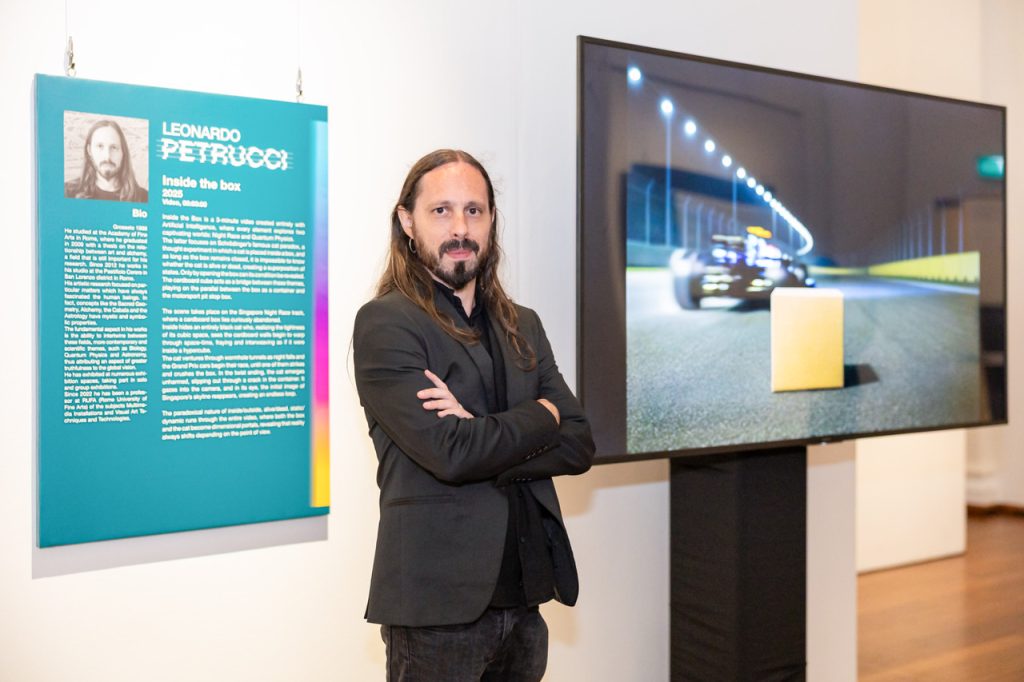
INSIDE THE BOX, 2025
Inside the Box is a 3-minute video created entirely with Artificial Intelligence, where every element explores two captivating worlds: Night Race and Quantum Physics. The latter focuses on Schrödinger’s famous cat paradox, a thought experiment in which a cat is placed inside a box, and as long as the box remains closed, it is impossible to know whether the cat is alive or dead, creating a superposition of states. Only by opening the box can its condition be revealed. The cardboard cube acts as a bridge between these themes, playing on the parallel between the box as a container and the motorsport pit stop box. The scene takes place on the Singapore Night Race track, where a cardboard box lies curiously abandoned. Inside hides an entirely black cat who, realizing the tightness of its cubic space, sees the cardboard walls begin to warp through space-time, fraying and interweaving as if it were inside a hypercube. The cat ventures through wormhole tunnels as night falls and the Grand Prix cars begin their race, until one of them strikes and crushes the box. In the twist ending, the cat emerges unharmed, slipping out through a crack in the container. It gazes into the camera, and in its eye, the initial image of Singapore’s skyline reappears, creating an endless loop. The paradoxical nature of inside/outside, alive/dead, static/dynamic runs through the entire video, where both the box and the cat become dimensional portals, revealing that reality always shifts depending on the point of view.
Jake Tan (SG), Ezequiel Ignacio Rodríguez Chiacchio (AR), Bao Song Yu (SG)
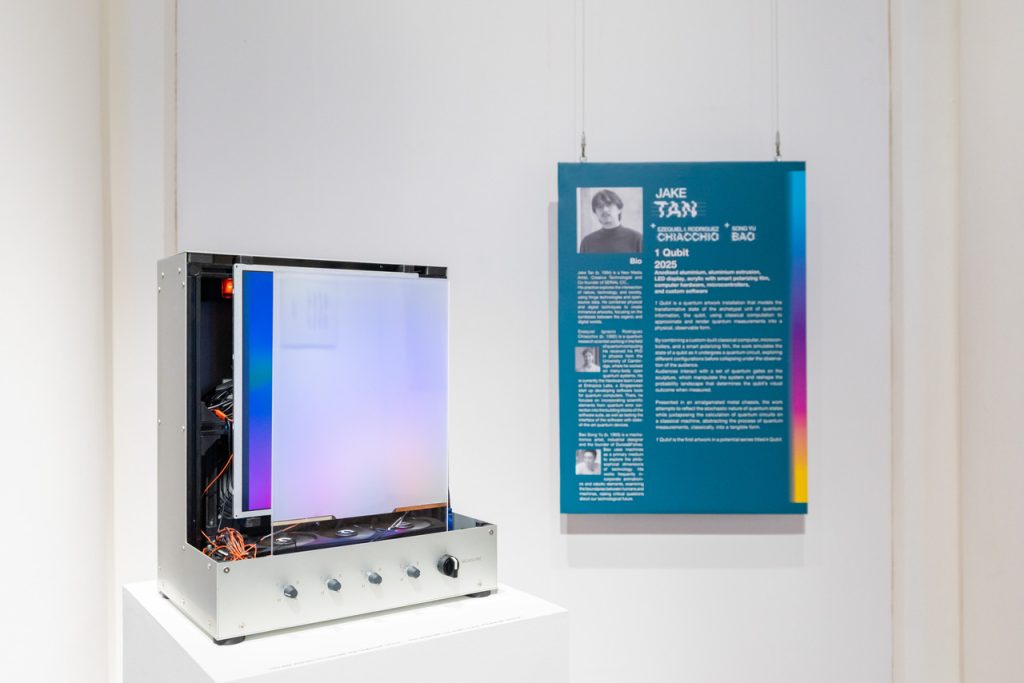
1 Qubit (2025)
1 Qubit is a quantum artwork installation that models the transformative state of the archetypal unit of quantum information, the qubit, using classical computation to approximate and render quantum measurements into a physical, observable form. By combining a custom-built classical computer, microcontrollers, and a smart polarizing film, the work simulates the state of a qubit as it undergoes a quantum circuit, exploring different configurations before collapsing under the observation of the audience. Audiences interact with a set of quantum gates on the sculpture, which manipulate the system and reshape the probability landscape that determines the qubit’s visual outcome when measured. Presented in an amalgamated metal chassis, the work attempts to reflect the stochastic nature of quantum states while juxtaposing the calculation of quantum circuits on a classical machine, abstracting the process of quantum measurements, classically, into a tangible form.
1 Qubit is the first artwork in a potential series titled k Qubit.
A Landmark Event in Singapore’s Cultural Calendar
The exhibition is part of the Grand Prix Season Singapore (GPSS25) program curated by the Singapore Tourism Board, cementing its status as one of the season’s most original cultural initiatives. Supported by the Embassy of Italy and the Italian Chamber of Commerce in Singapore, the project exemplifies the power of collaboration across disciplines and nations. The exhibition is included in the official program of UNESCO https://quantum2025.org/iyq-event/quantum-perspective-the-art-of-interference/
Thank to Nicola Bianchi, Diplomatic Advisor for scientific and technological relations at the Italian Embassy in Singapore and to Professor Catalina Curceanu at the Istituto Nazionale Fisica Nucleare for their generous contribution and intellectual vitality in building a bridge between disciplines.
Thank to Clara Pacifico Natoli, Gallery NM Contemporary (Monaco) for supporting our quantum project with her artists.
Experience the Quantum
Quantum Perspective: The Art of Interference is not only an exhibition but a journey into the mysteries of the universe, where abstract mathematics becomes emotion, and where the language of science finds its counterpart in artistic imagination.
Join us at The Arts House, 1–7 October 2025, for an extraordinary encounter at the frontier of art, science, and speed.
Exhibition Information
Exhibition Run: 1 to 7 October 2025
Opening Hours: 10am to 8pm
Location: The Arts House, 1 Old Parliament Lane, Singapore 179429
Admission: Free
Note: The inaugural 1 October 2025 will be open exclusively for authorities, sponsors, and VIP guests.
About DZE Asia Pte Ltd
DZE Asia Pte Ltd, a subsidiary of Dino Zoli Holding headquartered in Singapore, leads the motorsport industry with its cutting-edge race electronic and lighting systems. As a premier system integrator and general contractor, DZE Asia delivers customised solutions worldwide, enhancing performance and safety on race tracks. With a dedicated team and a commitment to innovation, DZE Asia, backed by Dino Zoli Holding, pushes the boundaries of motorsport infrastructure excellence, setting new standards globally.
About Dino Zoli Foundation
The Dino Zoli Foundation of Contemporary Art is a project dedicated to promoting and sustaining Italian culture at home and abroad. An important collection of modern and contemporary art is permanently hosted in its exhibition area. The Foundation is the cultural driver of the business activities listed under the Dino Zoli Group. For more information, visit https://fondazionedinozoli.com/en/
Contact:
Kawaljit Kaur
Quantum Perspective: The Art of Interference
The Arts House, Singapore
Email: info@dzeasia.com
Phone: +65 67349778